

 Türkçe
 Deutsch
 Svenska
 Norsk
Norsk Русский
 Español
 Français
“Shark Teeth”: Why Teeth Get Filed Down, and How to Avoid It
Medically reviewed by Dt. Şerife Kalken, dentist and founder · October 2026
Overview
What the “Shark Teeth” Videos Actually Show
You have probably seen them: short videos of a row of natural teeth ground down to small, pointed stumps, followed by a bright new smile. The stumps get called “shark teeth”, and the videos are often captioned as getting veneers in Turkey.
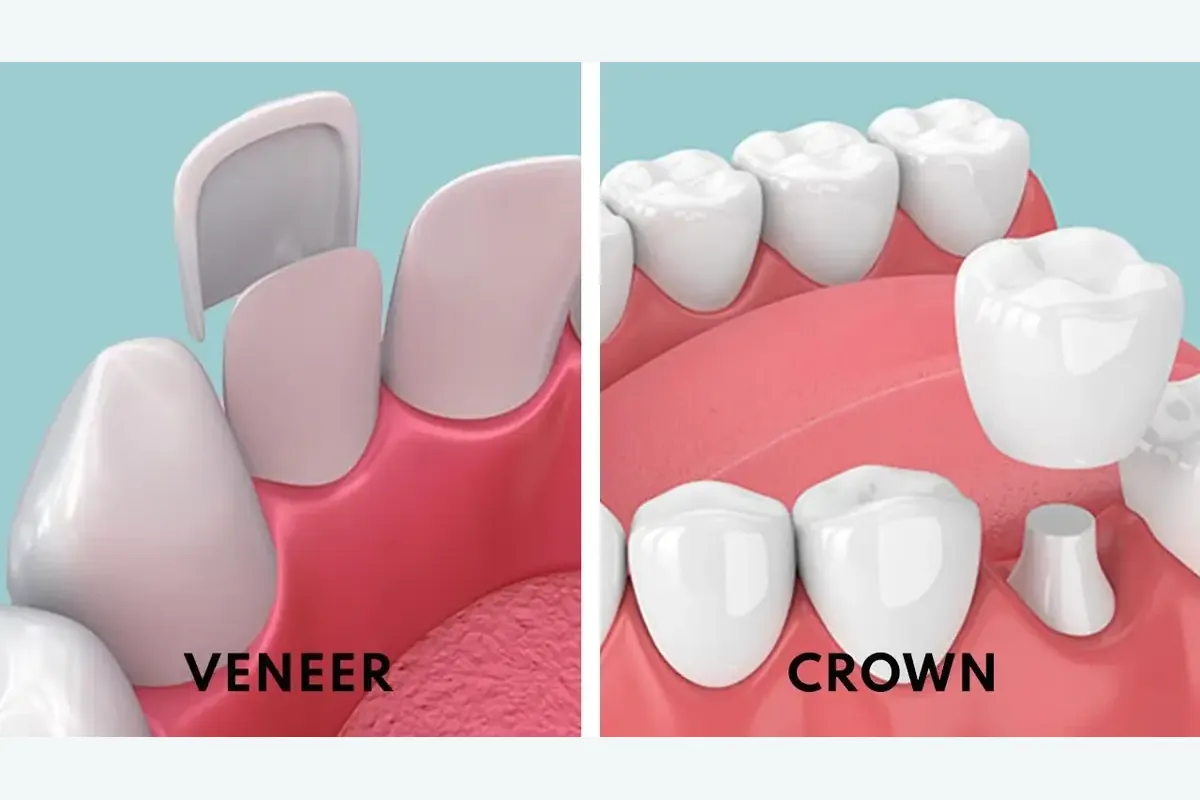
Here is the part the captions leave out. Teeth cut down to pegs are not being prepared for veneers. They are being prepared for full crowns. A veneer is a thin shell bonded to the front of a tooth; it needs a fraction of a millimetre of enamel taken off the front, and the tooth underneath still looks like a tooth. A crown wraps the whole tooth, so the tooth has to be reduced on every side to make room for it. That is what produces the peg.
Crowns are a legitimate treatment, and sometimes the right one. The problem in the videos is not crowns as such. It is healthy teeth being crowned for a cosmetic result that thinner, more conservative work could have given.
How Much Is Removed
Veneer, Crown or Bonding: What Happens to the Tooth
The difference between these options is mostly about how much natural tooth you keep.
Composite bonding
Least invasive
- What it is
- Tooth-coloured resin built up on the tooth and shaped by hand.
- Tooth removed
- Often none, or very little.
- Reversible?
- Largely, yes.
Porcelain or E-max veneer
Conservative
- What it is
- A thin ceramic shell bonded to the front surface.
- Tooth removed
- Typically 0.3–0.7 mm of enamel from the front.
- Reversible?
- No. The tooth will always need a veneer or similar covering.
Full crown
Most invasive
- What it is
- A cap covering the whole visible tooth.
- Tooth removed
- Typically 1.5–2 mm on every side. This is the “shark tooth”.
- Reversible?
- No. The tooth will need a crown for life.
Research puts numbers on it. A laboratory study of front teeth found that preparing a tooth for a full crown removed roughly 63–72% of the visible tooth structure, against roughly 3–30% for veneer preparations, depending on the design.
- Edelhoff D, Sorensen JA. Tooth structure removal associated with various preparation designs for anterior teeth. J Prosthet Dent. 2002;87(5):503–9.
- Summarised in Shenoy A. Survival rates of porcelain laminate restoration based on different incisal preparation designs. J Conserv Dent. 2011;14(2):203.
Why It Matters
What Happens to a Tooth Cut Down for a Crown
- It is permanent. Enamel does not grow back. A tooth prepared for a crown needs a crown for the rest of its life.
- The nerve can suffer. The more tooth is removed, the closer the work comes to the nerve. Some heavily prepared teeth become sensitive, and some later need root canal treatment.
- Every replacement costs more tooth. Crowns and veneers do not last forever. When they are replaced, the tooth is usually trimmed again.
- Gums react to poor edges. Bulky or badly fitting crown margins trap plaque at the gum line, which leads to bleeding and, over time, recession.
None of this means a crowned tooth is doomed. Well-made crowns on teeth that needed them can last for many years. It means a crown should be a clinical decision for a particular tooth, not a shortcut to a uniform smile.
Why Clinics Do It
Why Healthy Teeth Get Crowned
If crowns remove so much tooth, why do some clinics use them for cosmetic cases? Usually for reasons that suit the schedule rather than the patient:
- Speed. Crowns can cover crooked, dark or uneven teeth in one short trip, with no orthodontics, whitening or staged work first.
- Uniformity. Cutting every tooth to the same shape makes it easy to fit a row of identical units. That is also why some results look like a “white wall”.
- Loose language. “Veneers” is often used for anything that covers the front teeth, so patients agree to “veneers” and receive crowns.
Our guide to Turkey teeth gone wrong covers the other common causes, from treatment squeezed into a few days to bites that were never checked.
When a Crown Is Right
When a Crown Is the Right Treatment
A crown is often the best option for a tooth that is already badly damaged. Typical examples:
- a tooth that is mostly filling, or has a large crack;
- a back tooth after root canal treatment;
- a tooth worn down heavily by grinding;
- a tooth that is broken, or too dark to be masked by a veneer;
- a crown on a dental implant, where there is no natural tooth to preserve.
In a mixed case, the honest plan is usually mixed too: crowns on the teeth that need them, veneers or bonding on the ones that do not, and sometimes whitening on the rest. Our veneers vs crowns vs bonding guide goes through the choice tooth by tooth.
How to Avoid It
Five Questions to Ask Before Any Tooth Is Touched
“Is it a veneer or a crown, tooth by tooth?”
Ask for it in writing, with each tooth numbered. If the plan just says “20 veneers”, ask again.
“How much tooth will you remove?”
A clear answer is in millimetres. For a veneer it is usually a few tenths of a millimetre, on the front.
“Can I see the result before you start?”
A digital smile design or a trial mock-up lets you see the shape and length before anything irreversible happens.
“Would whitening, bonding or orthodontics do instead?”
For many people they would, at least for some teeth. A dentist who considers them is planning, not selling.
“When is my bite checked?”
Temporaries first, a try-in, and the bite checked before anything is cemented for good.
We answer these in writing for every cosmetic plan. Our plans name the treatment for each tooth, and we tell you when you do not need veneers on every tooth you can see.
FAQ
Frequently Asked Questions
- What are “shark teeth” in Turkey teeth videos?
They are natural teeth that have been cut down on every side, leaving small pointed stumps. That shape is the preparation for full crowns, not for veneers. A veneer only needs a thin layer of enamel removed from the front of the tooth.
- Do veneers need your teeth filed down to stumps?
No. A porcelain or E-max veneer typically needs 0.3–0.7 mm of enamel removed from the front surface, and composite bonding often needs none. If a plan involves cutting teeth down on all sides, it is a crown plan, whatever it is called.
- How much tooth is removed for a crown?
Typically 1.5–2 mm on every side. A laboratory study of front teeth found that full-crown preparations removed roughly 63–72% of the visible tooth structure, against roughly 3–30% for veneer preparations.
- Can shark teeth be reversed?
No. Enamel does not grow back, so a tooth prepared for a crown will always need a crown. What can often be done is to replace poor crowns with well-fitting ones and treat any nerve or gum problems underneath.
- When is a crown the right choice?
When a tooth is already badly damaged: mostly filling, cracked, heavily worn, root-canal treated or broken. Crowns are also used on dental implants. For healthy front teeth that only need a better colour or shape, veneers, bonding or whitening usually keep far more of the tooth.
Send us your X-ray and we will tell you where you stand
A dentist reviews it and you get a written plan. No charge, no deposit, and no obligation to travel.